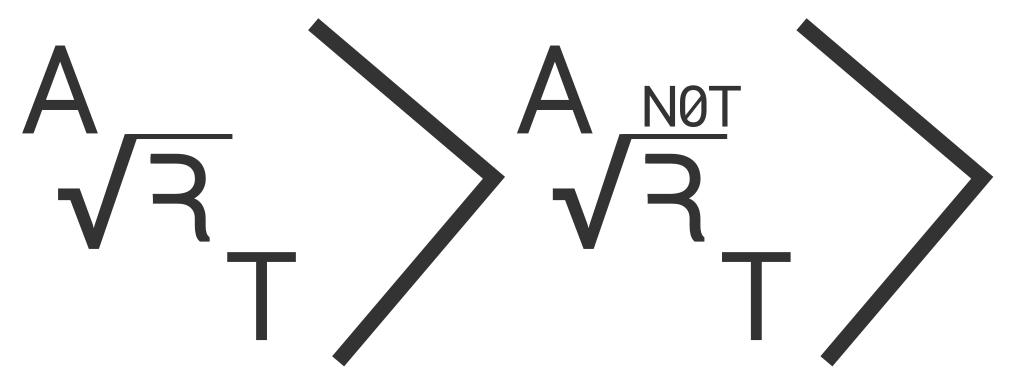
I read this paper, so you don’t have to — Alan Turing, Computing Machinery and Intelligence (1950)
The name of Alan Turing has become ubiquitous. Invoked as the founding father of AI, cited relentlessly as the one who saw it all coming, known for the ultimate test that can prove either a machine is thinking or just “faking it”, Alan Turing became The Name in the tech industry and transdisciplinary fields. So it seemed fundamental to break down the paper that laid the ground to his reputation.
More than being a technical assessment, Computing machinery intelligence, is an almost philosophical take on future capacities of machines. There is no code, no engineering diagrams, instead Turing reflects on a deeper problem: can machines think?
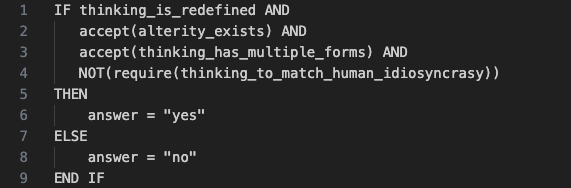
IF we redefine thinking by accepting that alterity exists and that thinking may take various forms as the faculty of thinking doesn’t necessarily has to be molded on human idiosyncrasy in order to be valid
THEN the answer is yes
ELSE the answer is no.
What Turing Actually Does in This Paper
Before proposing anything, Turing takes on the objections.
The theological one, the mathematical one, the “machines lack consciousness” one, the “they can only do what we tell them” one. Each objection is meticulously stated and then dismantled.
He challenges the idea that a machine must feel to think, that intelligence must be tied to a soul, or that rule-based processing is inherently limited. He also anticipates anxieties that still circulate today: the fear of deception, loss of control, or the idea that creativity is an exclusively human trait.
In short, the paper is less a technical blueprint and more a conceptual excavation. Turing clears the ground from centuries of inherited assumptions.
The Context: Mid-Century Anxiety, Optimism, and Intellectual Upheaval
Computing Machinery and Intelligence was written in 1950, at a moment when the world was still reorganizing itself after World War II (1939-1945). The atmosphere was a mix of scientific acceleration and existential dread. Several elements shaped the paper’s underlying tone:
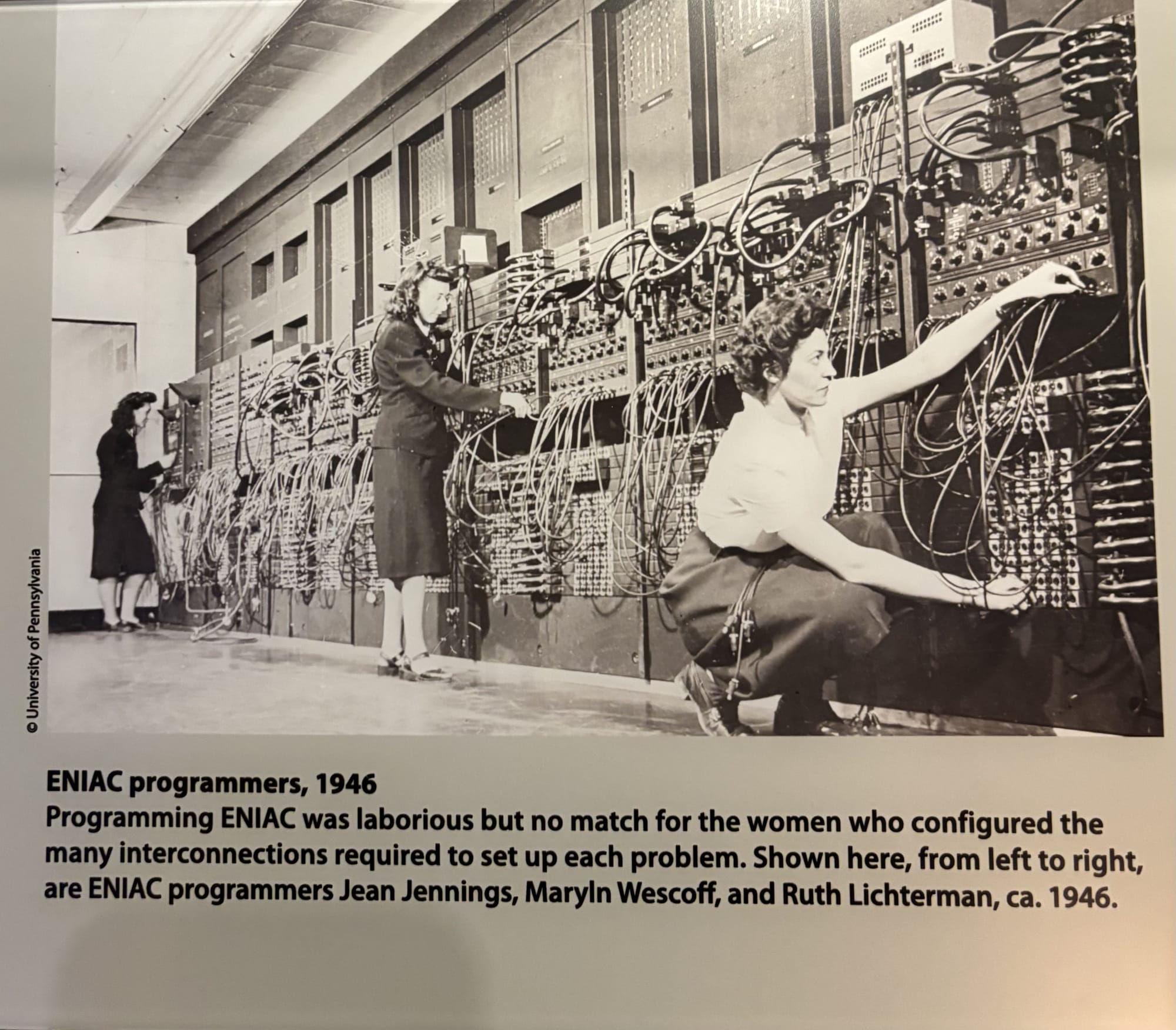
1. The Birth of the Electronic Computer (ENIAC 1945)
The first programmable computers had just appeared, enormous, fragile, room-sized machines pulsing with vacuum tubes. They were not yet part of public consciousness, but for mathematicians and cryptographers they represented an unprecedented conceptual shift:a machine could execute logic.
This was shocking. Machines were no longer industrial objects; they were edging into symbolic operations, traditionally considered human territory.
2. The Shadow of the War
Turing was writing only a few years after his cryptographic work at Bletchley Park, which itself had depended on the idea that machines could process information faster than humans ever could.
The war had shown, brutally, that technology could be both a salvation and a threat.
His question “can machines think?” therefore did not appear neutral; it hovered in a world that had just witnessed the destructive potential of engineered systems.
3. Philosophy in Turmoil
Mid-century philosophy was dismantling old certainties: Wittgenstein had destabilised language, cybernetics (Wiener) was rethinking systems and communication, early information theory (Shannon) was treating meaning as data.
The intellectual climate was ripe for a challenge to the uniqueness of human cognition. Turing’s paper sits inside this broader movement to reimagine the mind as process rather than essence.
4. A Post-Human Impulse Before Its Time
There was a subtle cultural fascination with the idea that the human was no longer the center of the universe. Turing’s proposal that thinking might not look like us, that it might have many forms, was disturbingly avant-garde.
He was effectively describing a proto-posthumanist concept in a world that still believed in strict human exceptionalism.
5. Social and Personal Silence
Woven into all this is something quieter: Turing was a queer man in a deeply homophobic Britain. His understanding of alterity, difference, and the possibility that intelligence might appear in an unexpected form, carries an emotional or existential resonance that the paper itself does not spell out, but the reader might feel these tensions between the lines.
The Turing Test (as we call it today)
In this paper Turing introduces, what he calls, the imitation game: a practical experiment replacing the vague question “can machines think?” with a more testable one: can a machine imitate a human well enough to be mistaken for one?
Today we refer to this as the Turing test, even though the contemporary version is somewhat extrapolated from his original description. The public narrative around it, the dramatic “human vs. machine” encounter, comes much later. Turing’s own framing is more subtle, more open, and very much anchored in the 1950s context.
Still, the core idea remains: intelligence is not about interiority; it is about performance within a communicative situation.
Style and Accessibility
Let’s be honest: this is not an easy paper.
There are mathematical detours, historical references, and a philosophical tone that assumes a highly trained reader. The writing is crisp but dense, academically rigorous, and very much a product of mid-century intellectual culture.
Some will find this exhilarating; others will find it impenetrable. It is not the kind of text one casually reads in the subway.
Final Rating
5 out of 5.
Not because it is flawless, but because it matters.
This is a paper for:
• computer science researchers,
• digital humanities scholars,
• philosophers of mind,
• anyone curious about the origins of AI,
• and anyone building their cultural understanding of how machines and thinking became entangled.
If you want the foundation, the spark, the premise upon which decades of debate were built this is it.
I read this paper, so you don’t have to.
If you want to read the paper you can find it here and don't be afraid to share, the more the merrier 😊