Marine Billet: Casting the Body Against Disappearance
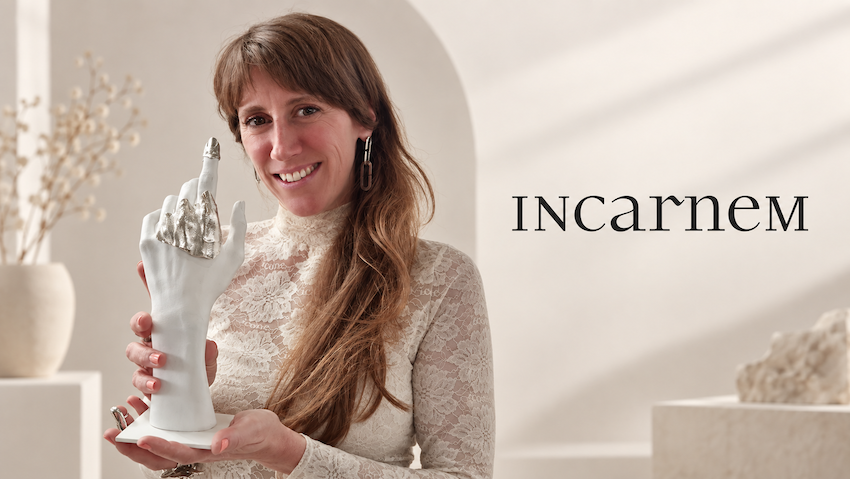
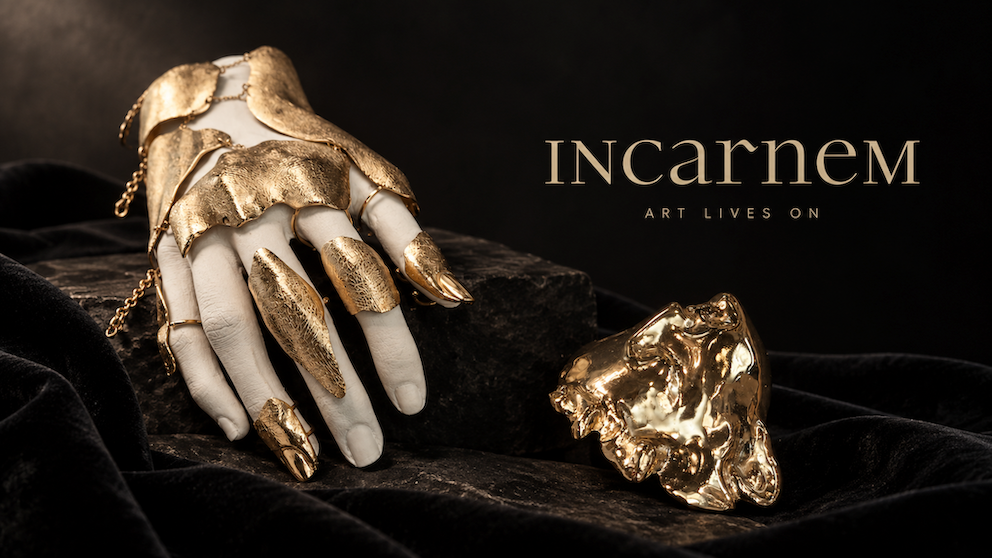
With Incarnem, Marine Billet transforms bodies, flowers, architectural fragments and intimate memories into jewellery. An ear can become a sculpture, a nipple a record of a body before surgery, a champagne wire an engagement ring, a tooth an unsettling meditation on identity.
Her practice exists somewhere between jewellery, sculpture, imprint and archive. At its centre lies a simple gesture, casting, but also a much larger question: what happens when we give permanence to something inherently destined to change?
We spoke about authorship, beauty, disappearance, imperfection and the strange possibility of one day inheriting the exact shape of a grandmother’s ear.
Your pieces exist somewhere between jewelry, sculpture, imprint and, at times, almost prosthesis. At what point does an object stop being jewellery and become something else? And does that boundary interest you?
Marine Billet: I think that boundary comes back unconsciously and constantly in my work, because I have trouble defining myself too. Sometimes I say I make sculpture on a small scale. Sometimes I say I’m a jeweller, sometimes a craftswoman, sometimes an artist. I’m a mixture of all of those things. So the boundary is very porous, and it interests me enormously. I tend to think I move closer to sculpture when the pieces become larger, when I change scale or start using tools that are no longer really jeweller’s tools. But people already tell me that my jewellery is quite imposing. To me, it simply has the scale it needs to have.
Take the ear, for example. When it isn’t being worn, you can put it in a beautiful box and suddenly it becomes a sculpture. For me, perhaps that is where the shift happens: when an object has a life of its own. When it remains interesting even when it is no longer being worn or used. When you still want to look at it. I’ve also made tableware, including small spoons. One client bought one and put it on his mantelpiece. He told me, “For me, this is a work of art.” I don’t think he’ll ever use it to eat.
At one point, I even wanted to make small frames for the ears and fingers. You could hang the jewellery on the wall when you are not wearing it. That’s what I love: the object lives by itself. When you wear it, it takes another dimension, but it already lives by itself.
You spent years materialising drawings imagined by others, notably at Schiaparelli. In a creative object, where do you locate authorship: in the person who has the idea, in the person who finds a way to make it possible, or somewhere between the two?
Marine Billet: Somewhere between the two, although perhaps it isn’t fifty fifty. The design belongs to the designer. It’s their idea. But the person making the piece brings a response that is completely unique. That’s something I understood after working for several years at Schiaparelli. My interpretation of Daniel Roseberry’s drawings or those of the house’s designers would not have been the same if someone else had made them. I have my own sensitivity, techniques, way of responding to a drawing. A drawing is never exactly what the finished object becomes. Often, you receive a single view, usually from the front. You have to imagine the volume. So yes, for me, the person making the piece is, in a way, a coauthor. Maybe the designer has sixty or seventy per cent of it, but the maker still has something to say.
It would actually be interesting to take the exact same drawing and give it to three different model makers. I’m sure you would get three completely different objects. The lung I made for Schiaparelli is a good example. The project arrived very late, about two weeks before the show, and all I had was a small hand drawn sketch. I knew they wanted something realistic, so I started looking through anatomy books to understand what a lung really looks like. Schiaparelli plays a lot with trompe l’œil, something extremely realistic, but with humour too. Between Daniel’s tiny sketch and the finished object, there was an enormous amount of interpretation. There were obviously many exchanges and adjustments, but I had to imagine the volume and propose my own version of it. That part was very creative.
Casting creates an interesting paradox. You reproduce a form that already exists, while we often associate creation with inventing something new. When you cast a body, a flower or a fragment of architecture, at what point does reproduction become creation?
Marine Billet: For me, it becomes creation through the act of casting itself. I almost never reproduce something in its entirety. Especially with architecture, I take fragments. That means my eye has already selected a particular detail. If it’s a flower, I have chosen that flower, perhaps precisely because one of its petals has begun to wither. With the body, it’s the same. I don’t cast the entire body. I take fragments. The way you cut something out, the boundary you give the imprint, the territory you decide to isolate: all of that is a choice. I don’t cast an entire wall. My eye decides that this particular detail deserves to be isolated, elevated and transposed into metal.
For me, creation begins there. I like to say: my gaze has value. I saw this tiny detail, and I want to steal it from reality and transpose it. Sometimes I transform the cast considerably afterwards. With architectural fragments, for example, I might bend or hammer them so that they follow the shape of the body and become bracelets. I take an existing material, and then I work on it. A cast preserves the presence of something that is no longer there when we look at the finished object: a body, a flower, a fragment of a city.
Casting preserves the presence of something that is no longer there by the time we look at the piece: a body, a flower, a fragment of the city. Are you ultimately working as much with absence as with matter?
Marine Billet: Yes, although I think it’s less about absence than about the possibility of disappearance. I’ve always been afraid of things escaping me or disappearing. Casting allows me to give these elements a form of durability, almost immortality. A finger changes. An ear changes. You cast a body at a particular moment, but the body continues to evolve. Flowers are destined to wilt. Architecture deteriorates. Everything eventually disappears or alters. I think that’s what I’m trying to resist with this technique. I can look at an object and think: “This is what it looks like now. If I come back in a year, it won’t be the same.”
So it’s really about capturing an instant. I’ve already had people contacting me before surgery. One woman was about to undergo a mastectomy because of cancer and wanted me to cast her nipple. She knew her body was about to change and wanted to keep a trace of it.
I imagine that, in the future, people whose fingers I cast today will also come back and tell me their hands have changed or their joints have grown. I haven’t been doing this long enough yet to experience that kind of distance in time, but I know it will happen.
An imprint also records irregularities: a scar, an asymmetry, a fold, an imperfection. When you make a cast, do you try to preserve exactly what you find, or do you allow yourself to “correct” it? And what does correcting a body mean once it becomes jewellery?
Marine Billet: Normally, I don’t correct it. I think the imperfection is precisely where the beauty lies. Of course, if a client explicitly asks me to change something they dislike, I will. But first, I try to understand why it bothers them. I once had a client who asked me to cast her belly button. It protruded, and she really didn’t like it. When I received the cast, I tried to show her that it was beautiful as it was, and that modifying it actually made the piece look stranger. Eventually, she agreed to keep it exactly as it was. I see those moments as little victories, because the work is also about celebrating the body as it is.
There are small things I’ll change quite easily, an uneven nail or a manicure someone isn’t happy with. And if someone genuinely needs something to be erased in order to feel comfortable with the piece, I’ll do it.
You have transformed ordinary elements into jewellery. What makes something precious to you: the material, the time required to make it, the gaze we place upon it, or the story attached to it?
Marine Billet: Definitely not its market value. Gold is beautiful to work with, of course, but I actually make very few pieces in gold. Time gives an object its value. I think you can feel when a lot of time has gone into something handmade. People often ask me, “How long did this take?” Sometimes I ask them to guess, because I think you can sense it. But in my own work, what makes an object truly precious is the encounter with the other person.
I like spending time with clients and hearing their stories. One of the most precious moments is when they receive the finished piece, when they’re surprised or overwhelmed by something that has been made specifically for them. Once I had a couple telling me they had a very important memory connected to a cherry tree. So we cast a cherry stem in silver, and I also used the cherry stone and placed a small precious stone inside it.
Another couple wanted wedding rings. One evening, they had spontaneously made rings for one another from the wire and metal left around a champagne cork. Obviously, they couldn’t really wear them. So I cast those improvised rings and transposed them into gold. They could keep the exact trace of that moment when, in their own informal way, they proposed to one another. For me, those stories are what make jewellery precious.
The piece is unique because it contains something that belongs to you. You can tell the story behind it, but even if nobody else knows it, it still means something. When clients come to me without a specific story, I ask questions. What connects you? Is there a place you travelled to together? An object you kept? A shell? A memory? Then I try to translate that into matter. My pieces are very organic and textured. People who come to me already know they won’t receive something perfectly smooth, polished and classical. I listen, I take notes, and then I try to find the material form hidden inside their story.
Jewellery has historically been associated with embellishment. Some of your pieces, particularly those that directly evoke anatomy, can also disturb, intrigue or even provoke disgust. Is beauty still a condition of jewellery for you?
Marine Billet: Beauty is deeply subjective, but it’s important to me that I find the jewellery I create beautiful.
One of the first rings I made for my jewellery school diploma contains one of my own teeth, a large molar. It sits inside a small, quite precious looking architectural structure. If you don’t know it’s a tooth, you might not immediately recognise it. I love that ring. I think it’s beautiful and interesting. But when I presented it for my diploma, it completely divided people. Some loved it. Others hated it. Some found it disturbing or even disgusting. It went beyond “beautiful” or “ugly”. They were physically repelled by it, and I found that interesting. I don’t want to please everyone. People sometimes look at my ear pieces and say, “It’s beautiful, but I would never wear it.” Which usually means they don’t actually like it very much, and that’s fine.
I don’t try to appeal to everyone. But the people who respond to my work respond to it very strongly. It either works or it doesn’t. That’s something I’ve wanted from the beginning. I never wanted to make something bland. My pieces speak for me. I don’t really need to introduce myself; when people see them, they understand something about my universe. And the tooth ring was actually made around the theme of identity. I chose my own tooth precisely because teeth are specific to each person. It was literally a fragment of myself.
Is there anything you would refuse to cast or transform into jewellery? Have you found an aesthetic, intimate or symbolic limit to your practice?
Marine Billet: From an aesthetic point of view, perfectly smooth skin without any relief, no muscle, tendon, bone, scar or mark, isn’t especially interesting to me. I might redirect someone toward another part of the body if I know the result will not be very visually interesting. But in terms of body parts themselves, I haven’t really encountered a limit.
There are certain intimate casts that I probably wouldn’t make myself. I would happily work from the cast, but I might ask the person to make the mould themselves. I’ve already worked with vulvas. I’ve made a ring from a cast of a glans. I haven’t done an anus yet, but it could happen. If you can make something beautiful, interesting or funny out of it, why not? Maybe that one would be more appropriate for an exhibition than for everyday wear.
Imagine that a single Incarnem piece survives for two hundred years and is discovered as an archaeological object from our time. What would you want it to say about our relationship to the body, beauty and the world today?
Marine Billet: First of all, I would love for an Incarnem piece to be found by archaeologists in two hundred years.
If it were discovered by a civilisation that knew absolutely nothing about us, I’d like them to look at it and think: these people celebrated their bodies. Maybe they would imagine we used these objects in some sort of shamanic ritual. I don’t know. But I would want it to evoke joy. A kind of self adoration, in the positive sense: finding your body beautiful, celebrating your skin and being comfortable in that celebration. What really excites me is the idea of transmission. I sometimes think about the end of my career and imagine clients who have had children, perhaps even grandchildren, saying: “I passed my ear down to her.” Maybe it won’t fit her perfectly because their ears aren’t identical. Maybe she’ll wear it anyway. Or maybe she’ll keep it as an object. And one day someone might tell me: “My grandmother gave me this. She’s gone now, but I still have her ear.”
Jewellery already has this idea of transmission and memory attached to it. But here, you are literally transmitting a piece of yourself.
Marine Billet: I think about people I loved who have died, before I was doing this work, and sometimes I wish I had taken a tiny cast, just one detail. A lot of my friends are having children now, so I suggest casting a toe or a tiny finger while they’re babies. I once cast the fingers or toes of a friend’s son when he was only a few months old. He’s three now. A photograph of yourself as a baby is already strange. But imagine holding your own toe at actual scale from when you were six months old. Turning it around in your hand and thinking: this was me. This was literally part of my body.
There is something very particular about volume. The jewellery doesn’t reproduce the texture of skin, of course. But it preserves the exact scale. The object is durable. It won’t rot. You can hold your own ear in your hand, almost as if you were holding a piece of yourself. When you transmit it, you can say: “This was my grandmother. This was my grandfather.” You can touch it.
Touch is strangely absent from memory.
We remember smells. We remember voices. We have photographs. We have visual memories. But the physical apprehension of volume is something we often lose. Of course, we sometimes inherit objects that belonged to someone. But here, the object you inherit has the actual shape of that person’s body. That’s what fascinates me. I can’t wait to see what these pieces become over time.
Maybe we’ll have to do another interview in twenty years...