The Mathematical Mind: How Art Emerges from Patterns and Processes
From Greek proportions to GANs, art emerges when minds—and machines—refine patterns through iterative feedback, showing how disciplined mathematics blossoms into creative expression.
Perhaps we approach this question with too much reverence for the ineffable nature of human creativity, forgetting that art has always emerged from systematic processes. The sale of an AI-generated portrait for $432,500 at Christie’s auction house forces us to confront an uncomfortable truth: the boundary between “art” and “what is not art” has never been as clear as we pretend.
When a Generative Adversarial Network creates a painting that moves viewers to tears, sells for hundreds of thousands of dollars, and hangs in galleries alongside Old Masters, we face a fundamental question: what makes art “art”? The answer may lie not in defending human creativity against mechanical reproduction, but in recognizing that art has always emerged from the intersection of systematic methodology and creative expression—whether in biological neural networks or artificial ones.
Ancient Foundations: Mathematics as Divine Beauty
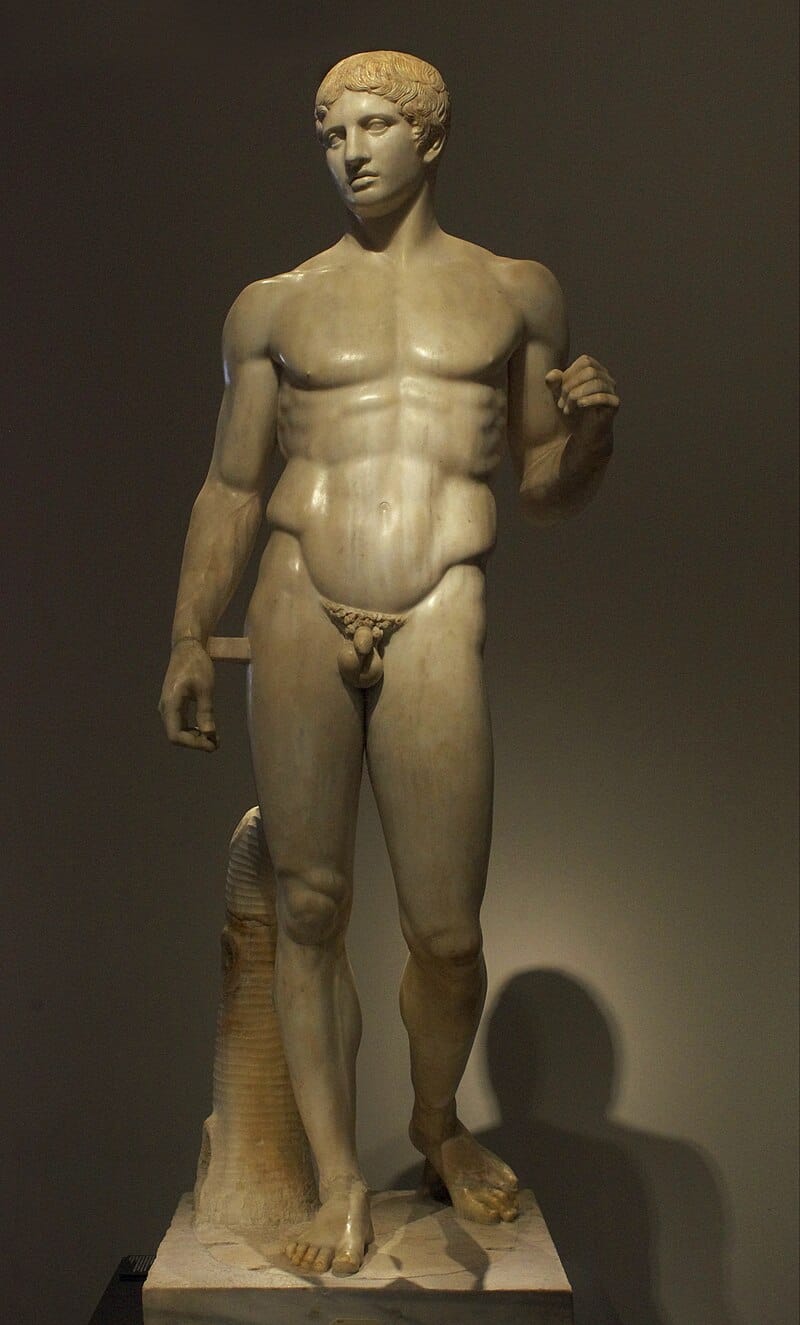
The Greeks understood something we seem to have forgotten: mathematics and beauty were not opposing forces, but expressions of the same underlying harmony. When Polykleitos sculpted his Doryphoros (the Spear Bearer) around 440 BCE, he wasn’t simply carving stone—he was implementing a mathematical system he called the “Canon,” a precise set of proportional relationships that governed every measurement from the distance between the eyes to the ratio of torso to limbs.
This wasn’t mechanical reproduction; it was the systematic pursuit of divine perfection through numerical relationships. Polykleitos himself wrote that “perfection comes about little by little through many numbers"(Philo of Byzantium, Belopoeica). The golden ratio (φ = 1.618…) appeared not just in temple architecture like the Parthenon, but in the proportions of idealized human forms, creating what the Greeks believed was a mathematical pathway to transcendent beauty.
The Pythagoreans went further, proposing that all aesthetic experience could be reduced to numerical relationships—the same mathematical intervals that create harmony in music also governed the proportions of beautiful objects. This wasn’t seen as reducing art to mere calculation, but as revealing the cosmic order that underlies all creation.
Renaissance Revolution: Systematizing the Sacred
The Renaissance masters transformed art not through inspiration alone, but through the systematic application of mathematical principles. Filippo Brunelleschi’s revolutionary experiments with linear perspective around 1415 weren’t artistic intuitions—they were methodical investigations into the geometry of vision. Using mirrors, measurement devices, and precise calculations, Brunelleschi developed a mechanical system for representing three-dimensional space on flat surfaces.
Leon Battista Alberti codified these discoveries in De pictura (1435), creating what was essentially an algorithm for realistic representation:
“First of all, on the surface on which I am going to paint, I draw a rectangle of whatever size I want, which I regard as an open window through which the subject to be painted is seen” (Alberti, On Painting, Book I).
His systematic approach included precise mathematical formulas for placing figures, calculating proportions, and achieving atmospheric perspective.
Leonardo da Vinci exemplified this marriage of systematic method and creative vision. His notebooks reveal an almost obsessive application of mathematical principles: anatomical studies based on geometric proportions, engineering drawings that follow precise mechanical principles, and artistic compositions governed by mathematical relationships. In his Trattato della Pittura, Leonardo wrote that “no human investigation can be called real knowledge without going through mathematical tests” (Leonardo da Vinci, Treatise on Painting).
Even Van Gogh, often romanticized as a purely emotional painter displayed an almost algorithmic consistency in his brushstrokes patterns—systematic repetition and variation that creates visual rhythm through methodical application rather than spontaneous expression.
The Machine Aesthetic: 20th Century Systematic Creativity
The early 20th century witnessed a remarkable paradox: as industrial machines transformed society, avant-garde artists began deliberately embracing mechanical processes to eliminate human subjectivity from their work. This movement represents the crucial bridge between Renaissance mathematical systematization and contemporary AI generation.
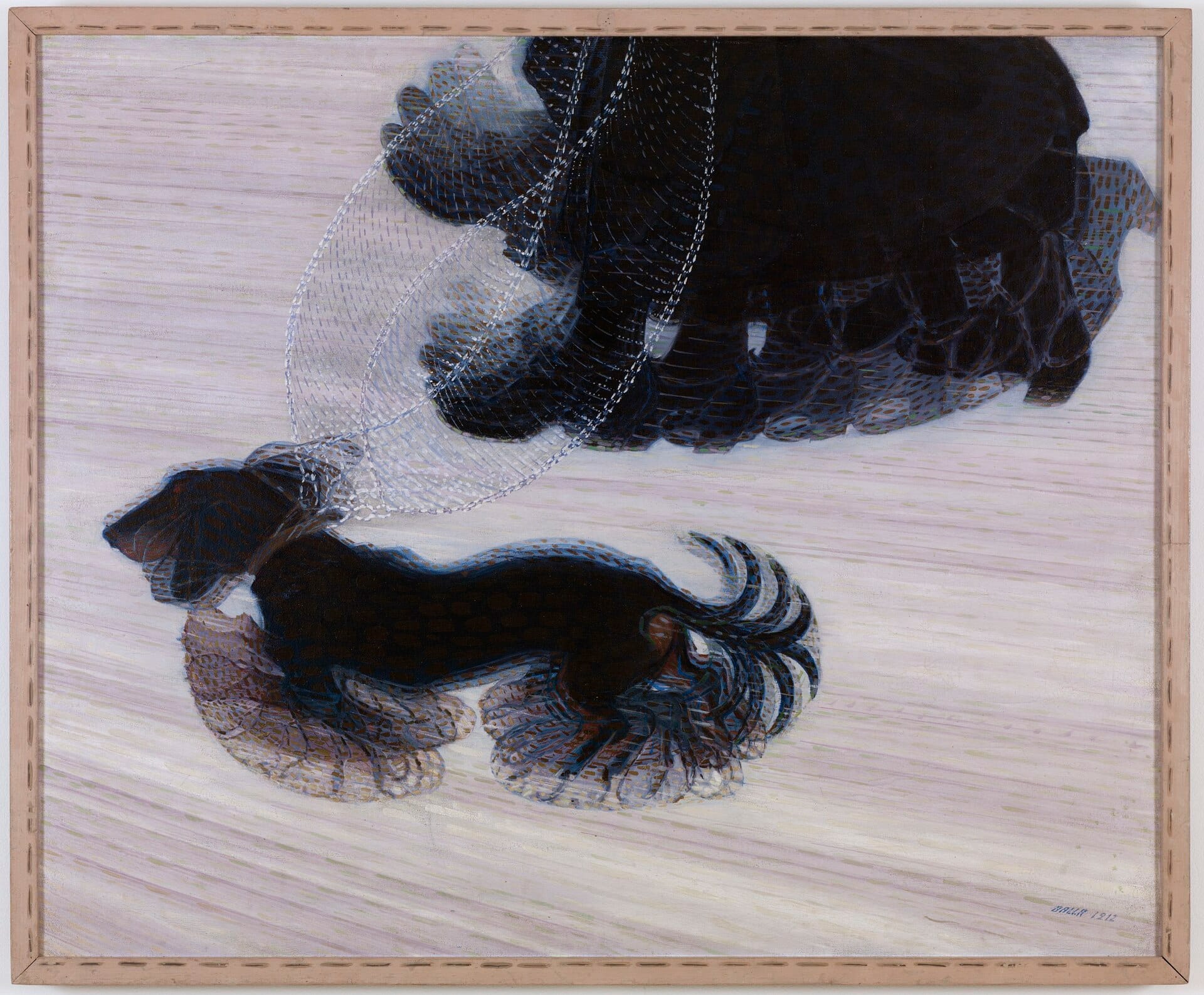
The Futurists explicitly celebrated machine aesthetics and industrial processes. Giacomo Balla’s Dynamism of a Dog on a Leash (1912) used systematic repetition to simulate mechanical motion.
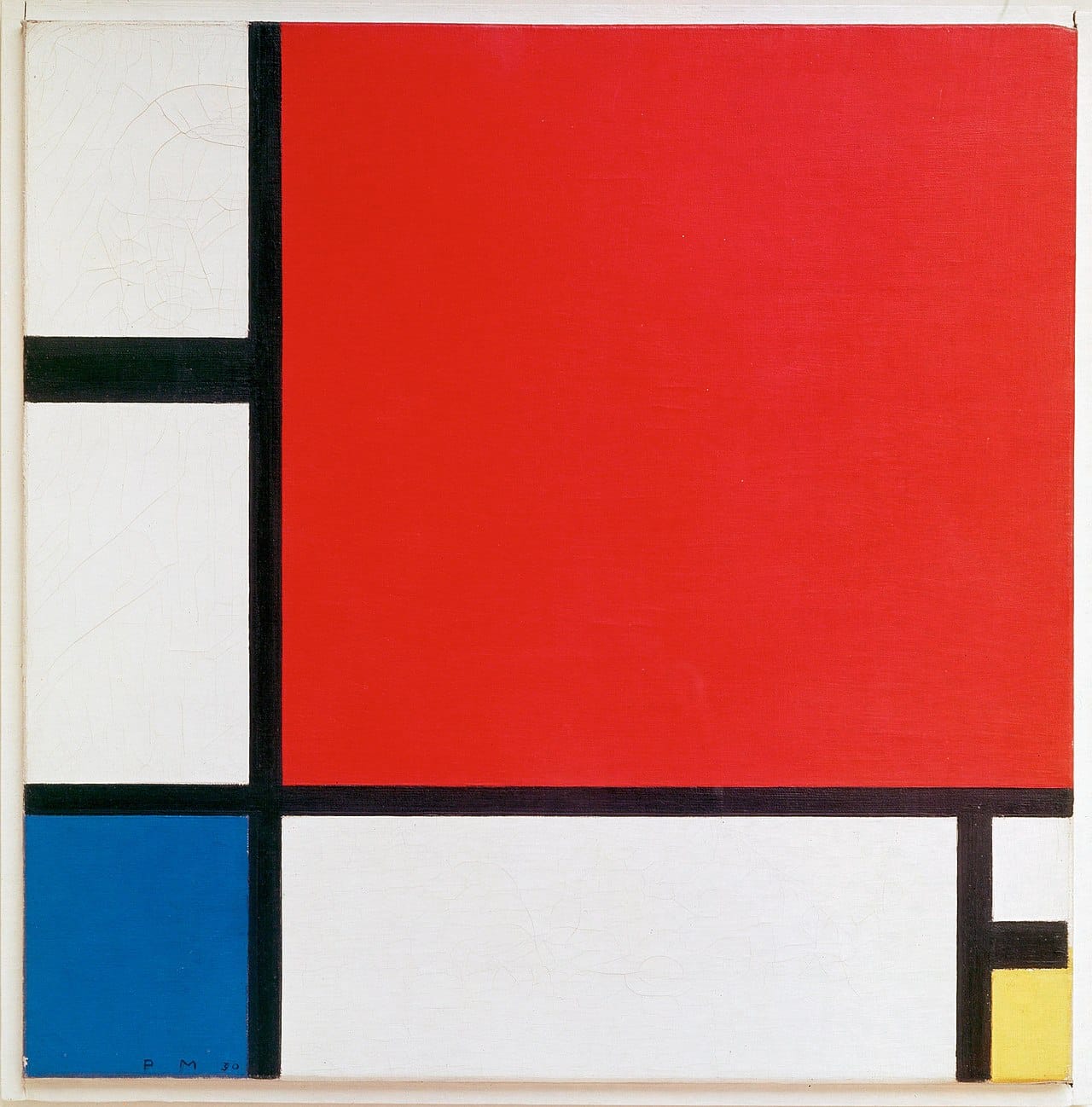
Piet Mondrian embraced mathematical order as a guiding principle for his art. By reducing his compositions to simple geometric shapes and primary colors, he sought to create a universal harmony that reflected an underlying cosmic order. Mondrian’s approach is a perfect example of how 20th-century artists used mathematical thinking not just as a tool, but as a philosophy to shape their artistic vision.
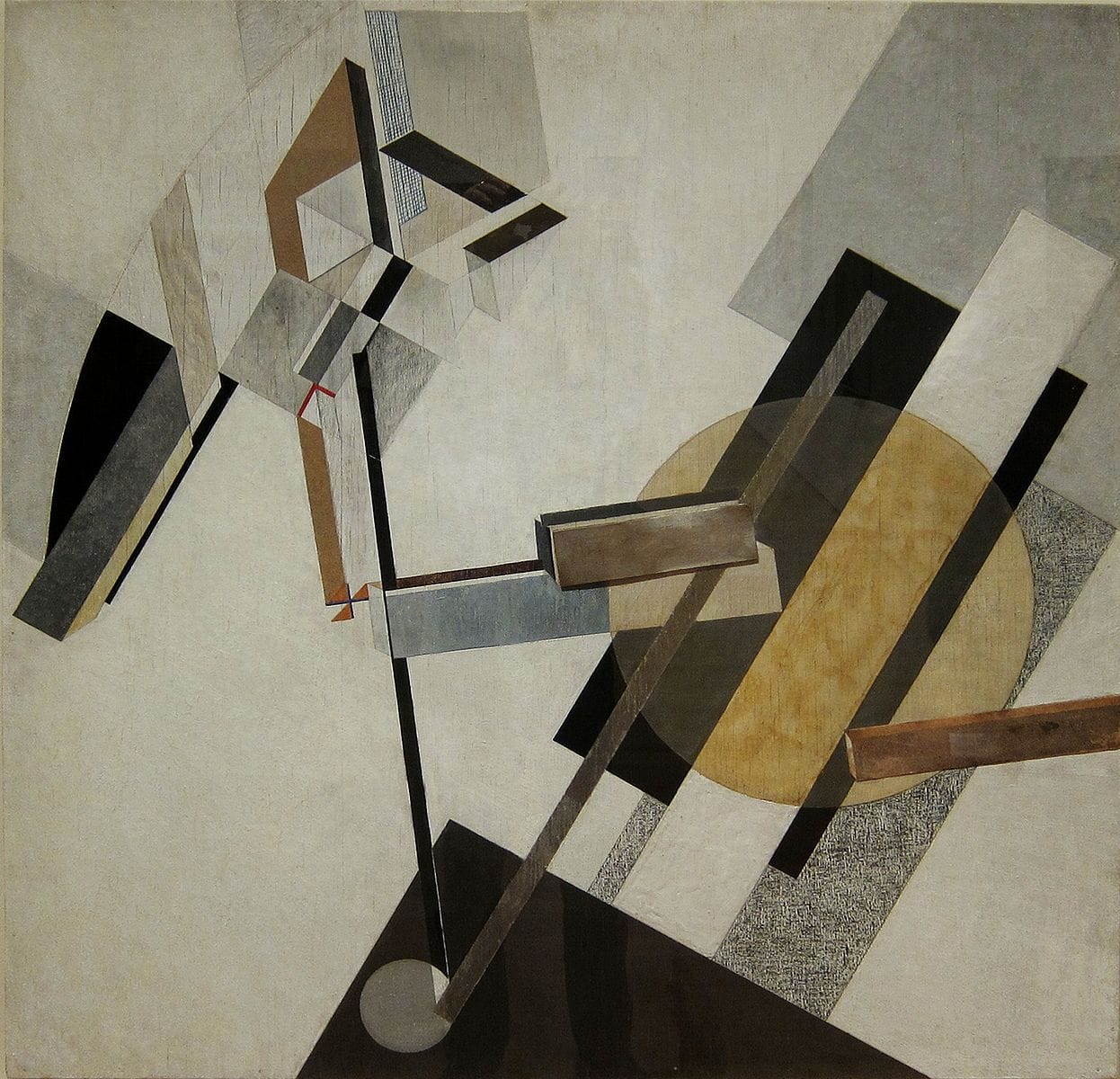
Russian Constructivists took this further, with El Lissitzky and Alexander Rodchenko using geometric principles and industrial materials to create art through systematic construction rather than personal expression. Lissitzky’s Proun series applied architectural and engineering principles to two-dimensional composition, treating artistic creation as a form of technical problem-solving.
Marcel Duchamp’s readymades represented perhaps the most radical elimination of artistic subjectivity. By selecting manufactured objects and declaring them art, Duchamp removed not just the artist’s hand, but the entire traditional creative process. His Fountain (1917) asked the same question we face with AI art: can systematic selection, rather than personal creation, constitute artistic practice?
John Cage extended this logic through chance operations, using the I Ching to eliminate personal choice from composition. His Music of Changes (1951) was generated through systematic consultation of random processes—an analog precursor to algorithmic generation. Sol LeWitt’s instruction-based wall drawings pushed even further: he created algorithms for others to execute, separating conception from execution in ways that prefigure contemporary AI art generation.
These artists weren’t rejecting creativity—they were exploring how creativity could emerge from systematic constraints and mechanical processes. They intuited what we now understand about both biological and artificial learning: that removing conscious control can sometimes unlock new forms of creative expression.
The Neural Connection: Parallel Systems with Different Constraints
To understand why mathematical approaches to art feel natural, we must examine how creativity emerges in both biological and artificial systems. While these represent parallel implementations of pattern-learning architectures, understanding their relationship requires acknowledging both genuine similarities and crucial differences. These systems operate as different solutions to the same fundamental challenge: how to learn, recognize, and generate complex patterns from experience.
Genuine Similarities: The Core Learning Architecture
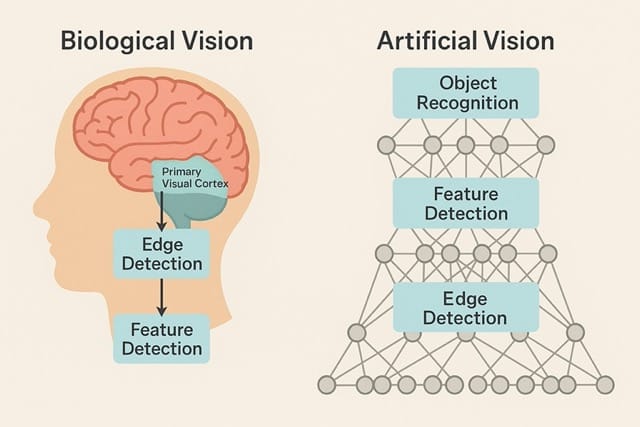
Both biological and artificial systems process information through hierarchical pattern recognition using weighted connections that strengthen or weaken based on experience. In biological vision, information flows from simple edge detection in the primary visual cortex to increasingly complex feature recognition in higher brain areas—the same architectural principle that governs artificial convolutional neural networks.
Dopamine: The Brain’s Learning Algorithm
The human brain operates as a massively parallel pattern-recognition system, with approximately 86 billion neurons forming around 100 trillion synaptic connections. Recent neuroscience research reveals that creativity involves three important dopaminergic reward circuits: the nigrostriatal pathway, the mesolimbic pathway, and the mesocortical pathway. Dopamine functions as the brain’s learning signal, released when we encounter unexpected rewards and stamping-in memories that attach motivational importance to otherwise neutral stimuli.
When an artist experiences a creative breakthrough, dopamine neurons fire in response to the unexpected success, strengthening the neural pathways that led to that discovery. This creates a learning mechanism remarkably similar to artificial systems: the brain learns through prediction error, strengthening connections that produce valuable, unexpected results.
Backpropagation: The Machine’s Learning Algorithm
Artificial neural networks learn through a parallel process called backpropagation. The algorithm works by calculating the loss function—the difference between expected and actual outputs—then systematically adjusting network weights to minimize future errors. This creates the same basic learning loop as biological systems: prediction, error detection, and systematic adjustment.
A Generative Adversarial Network (GAN) extends this principle through adversarial training—two networks compete against each other, with the generator learning to create increasingly convincing outputs by repeatedly failing and adjusting its approach. The learning mechanisms show remarkable parallels: dopamine-based reward prediction error mirrors loss function optimization in artificial networks.
Crucial Differences: Context, Integration, and Consciousness
However, biological creativity operates within fundamentally different constraints. Human brains integrate multiple information streams simultaneously—visual, auditory, emotional, social, and memory-based inputs all influence creative output. The dopaminergic reward system connects to emotional centers, social cognition networks, and autobiographical memory in ways that infuse creative acts with personal and cultural meaning.
Biological systems also demonstrate continuous, contextual learning. Human artists don’t just learn patterns from training data; they actively seek new experiences, form intentional goals, and consciously experiment with techniques. A painter might deliberately study Byzantine mosaics to influence their contemporary practice—a form of targeted, purposeful learning that current AI systems cannot replicate.
Most importantly, human creativity involves consciousness and intentionality, though we don’t fully understand these phenomena. When Van Gogh applied systematic color theory, he did so within a broader intentional framework of emotional expression and artistic communication. His swirling skies and fluid brushwork—especially in works like Starry Night—unintentionally mirrored mathematical patterns found in turbulent fluid dynamics. As explored in Natalya St. Clair’s TED-Ed analysis, Van Gogh’s visual structures align closely with the statistical properties of physical turbulence, revealing that his expressive technique also reflected deep, systematic principles from mathematics and physics.
Parallel Implementations of Pattern-Learning Systems
Rather than claiming biological and artificial neural networks are identical, we should understand them as parallel implementations of pattern-learning systems with different evolutionary pressures and design constraints. Biological networks evolved for survival and reproduction in complex social environments; artificial networks are optimized for specific tasks within constrained domains.
Both systems exhibit emergent properties where complex behaviors arise from simple interactions. Neither a jazz musician nor a GAN consciously calculates every aspect of their output; instead, sophisticated responses emerge from the accumulated learning embedded in their network structures. Both demonstrate that creativity emerges not from mysterious inspiration, but from the systematic exploration of pattern space within learned constraints. To illustrate this point, please refer to the accompanying down bellow GIF that shows a DcGAN’s learning process over 198 training epochs.
Contemporary Convergence: The Continuation of Artistic Evolution
The rise of AI-generated art represents not a break with artistic tradition, but its continuation through new technological means. The 20th century avant-garde prepared us for this moment by demonstrating that systematic processes and mechanical methodologies could produce genuine creative expression.
When a GAN learns to paint by analyzing thousands of existing artworks, it follows the same fundamental process that human artists have always used: systematic study, repetitive practice, pattern recognition, and gradual refinement through feedback. The adversarial training process mirrors both the traditional master-apprentice relationship and the modernist embrace of systematic constraints: the discriminator network acts as a demanding critic, rejecting crude attempts and forcing the generator to achieve increasingly sophisticated results.
Critics who dismiss AI art as “not real art” because it emerges from mathematical processes make the same mistake as those who once rejected Greek mathematical proportions as mechanical, Renaissance perspective as artificial trickery, or modernist systematic approaches as unartistic. They misunderstand the fundamental continuity in artistic evolution: each generation develops new systematic approaches to creative expression, often facing initial resistance before eventual acceptance.
The boundary between “art” and “what is not art” has always been permeable and contested, shifting as new methodologies emerge. What we’re witnessing with AI isn’t the mechanization of creativity, but the revelation that creativity—whether implemented in biological neural networks or silicon chips—has always been more systematic than our romantic notions suggest.
This parallel development doesn’t diminish either biological or artificial creative achievements. Instead, it reveals that systematic, pattern-based learning represents a fundamental approach to intelligence and creativity. The mathematical principles that guided Greek sculptors, Renaissance painters, and modernist systematicians reflect the same underlying pattern-seeking processes that now enable artificial systems to generate compelling artworks.
Perhaps the question isn’t whether machines can create art, but whether we’re ready to acknowledge that art—human or artificial—emerges from the beautiful complexity of pattern, process, and systematic exploration within learned constraints. The mathematical mind, whether implemented in biological neural networks or silicon chips, doesn’t diminish creativity—it reveals creativity’s deepest foundations.
In the end, Polykleitos, Duchamp, and GANs share more than we might expect: all demonstrate that systematic methodology, far from opposing artistic expression, provides the foundation from which genuine creativity emerges. The tools and contexts change, but the underlying principle remains constant—art arises when pattern-seeking minds encounter systematic constraints and find beautiful solutions within them.
📖 Bibliography
🏛️ Ancient & Classical Sources
- Philo of Byzantium. Belopoeica. Quoted in: Mark J. Schiefsky Technē and Method in Ancient Artillery Construction: The Belopoeica of Philo of Byzantium.
- Plato. Timaeus. Trans. Donald J. Zeyl. Hackett Publishing, 2000.
- Aristotle. Metaphysics. Trans. W.D. Ross. Book A, Chapter 5.
🎨 Renaissance to Modern Aesthetics
- Alberti, Leon Battista. On Painting. Trans. John R. Spencer. Yale University Press, 1956.
- Brunelleschi, Filippo. Referenced through Vasari’s Lives of the Artists and Alberti’s On Painting.
- Leonardo da Vinci. Treatise on Painting. Trans. A. Philip McMahon. Princeton University Press, 1956.
- Mondrian, Piet. Neo-Plasticism in Pictorial Art (1917). In The New Art – The New Life, ed. Harry Holtzman & Martin S. James. Da Capo Press, 1993.
- Duchamp, Marcel. The Essential Writings of Marcel Duchamp. Ed. Michel Sanouillet and Elmer Peterson. Thames & Hudson, 1975.
- Cage, John. Silence: Lectures and Writings. Wesleyan University Press, 1961.
- LeWitt, Sol. “Paragraphs on Conceptual Art.” Artforum, 1967.
🧠 Neuroscience & Cognitive Science
- Schultz, Wolfram. “Dopamine reward prediction error coding.” Dialogues in Clinical Neuroscience, 2016.
- Berridge, Kent, and Robinson, Terry. “Parsing reward.” Trends in Neurosciences, 2003.
- Friston, Karl. “The free-energy principle: a unified brain theory?” Nature Reviews Neuroscience, 2010.
- Gazzaniga, Michael S. The Cognitive Neurosciences, 6th ed. MIT Press, 2020.
🤖 AI & Machine Learning
- Goodfellow, Ian et al. “Generative Adversarial Networks.” Communications of the ACM, 2020.
- GOERTZEL, Ben. The General Theory of General Intelligence: A Pragmatic Patternist Perspective, 2021.
- LeCun, Yann; Bengio, Yoshua; Hinton, Geoffrey. “Deep learning.” Nature, 2015.
- Mitchell, Melanie. Artificial Intelligence: A Guide for Thinking Humans. Farrar, Straus and Giroux, 2019.
🎨 AI & Art History / Theory
- Domingos, Pedro. The Master Algorithm. Basic Books, 2015.
- Elgammal, Ahmed et al. “CAN: Creative Adversarial Networks.” arXiv preprint, 2017.
🔬 Vision & Perception Science
🌌 Additional / Popular Reference
- St. Clair, Natalya. “The unexpected math behind Van Gogh’s ‘Starry Night.’” TED-Ed. https://ed.ted.com/lessons/the-unexpected-math-behind-van-gogh-s-starry-night-natalya-st-clair
- Balla, Giacomo and Depero, Fortunato. Futurist Reconstruction of the Universe. 1915.